The first three digits of a ZIP code are its prefix. They identify the sectional center facility (SCF), the regional processing plant that sorts mail for a group of post offices. ZIP codes that share a prefix are geographically close, which is why the prefix is often used for shipping zones, sales territories and quick geographic grouping.
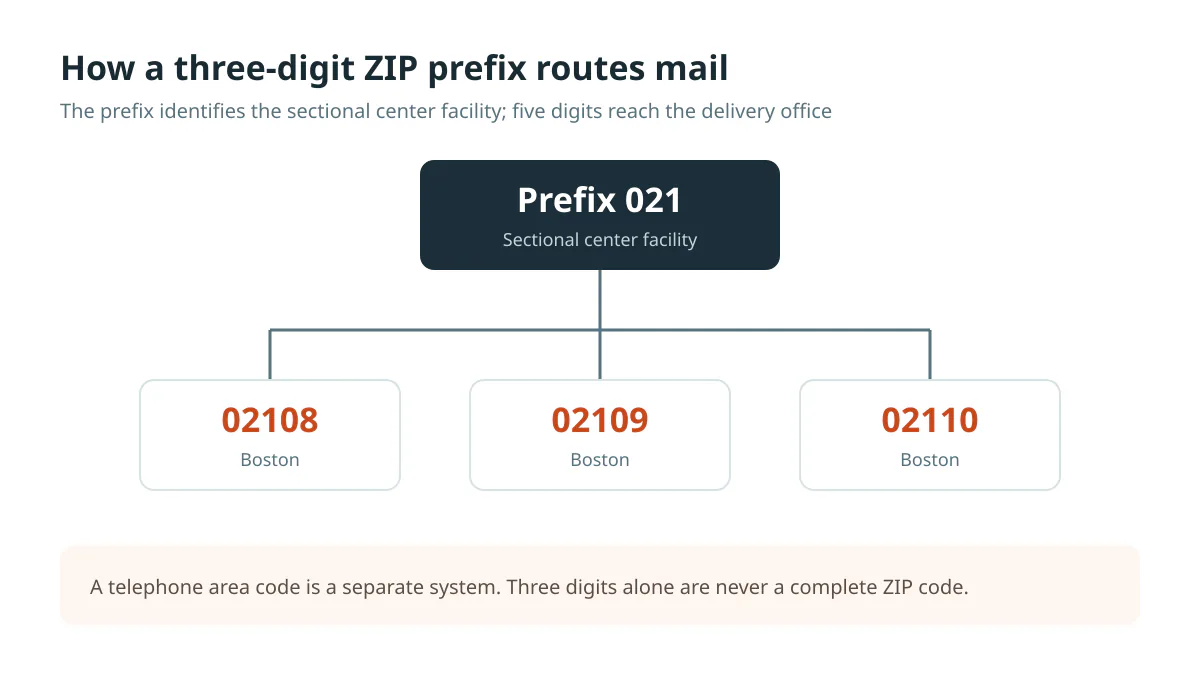
How prefixes fit into a ZIP code
The first digit is the national area, the first three digits together are the SCF, and all five digits identify the delivery post office. A prefix is never a complete ZIP code: 021 covers dozens of ZIP codes across Boston and its suburbs, and mail addressed to “021” alone cannot be delivered.
Why a three-digit search returns no ZIP
Searches such as “213 zip code” or “what zip code is 646” usually mix up two systems. 213 and 646 are telephone area codes, and three digits can also be the start of many different ZIP codes. Enter all five digits to find a ZIP, or search by city and state. Our prefix pages show what the dataset holds for the most searched three-digit numbers: 213, 260, 336, 412, 434, 480, 484, 614, 646, 724, 786, 814, 833, 913.
Telephone area codes are a different system
Area codes are assigned under the North American Numbering Plan by a telecommunications administrator, not by USPS. Their map does not follow postal routing: a city's area code and its ZIP prefixes are normally different numbers, and an area code can cover several ZIP prefixes or vice versa. Nothing in a phone number tells you a postal code.
Using prefixes in your own data
Grouping customers or shipments by the first three digits is a reasonable shortcut for regional analysis, because the SCF areas are contiguous. It is not a substitute for the full ZIP when you need a specific city, county or delivery point. Keep ZIP codes as five-character text and derive the prefix with a formula such as =LEFT(A2,3).
Three-digit ZIP prefixes by state
Prefixes found in the reference dataset for each state and territory. Use it as a guide: a prefix range tells you the state, but only the full five digits identify a delivery area.
| State or territory | ZIP prefixes |
|---|---|
| Alabama | 350–352, 354–369 |
| Alaska | 995–999 |
| American Samoa | 967 |
| Arizona | 850–853, 855–857, 859–860, 863–865 |
| Arkansas | 716–729 |
| California | 900–908, 910–928, 930–961 |
| Colorado | 800–816 |
| Connecticut | 060–069 |
| Delaware | 197–199 |
| District of Columbia | 200, 202–205, 569 |
| Florida | 320–339, 341–342, 344, 346–347, 349 |
| Georgia | 300–319, 398–399 |
| Guam | 969 |
| Hawaii | 967–968 |
| Idaho | 832–838 |
| Illinois | 600–620, 622–629 |
| Indiana | 460–479 |
| Iowa | 500–516, 520–528 |
| Kansas | 660–662, 664–679 |
| Kentucky | 400–418, 420–427 |
| Louisiana | 700–701, 703–708, 710–714 |
| Maine | 039–049 |
| Marshall Islands | 969 |
| Maryland | 205–212, 214–219 |
| Massachusetts | 010–027, 055 |
| Michigan | 480–499 |
| Minnesota | 550–551, 553–567 |
| Mississippi | 386–397 |
| Missouri | 630–631, 633–641, 644–658, 726 |
| Montana | 590–599 |
| Nebraska | 680–681, 683–693 |
| Nevada | 889–891, 893–895, 897–898 |
| New Hampshire | 030–038 |
| New Jersey | 070–089 |
| New Mexico | 870–871, 873–884 |
| New York | 005, 063, 100–149 |
| North Carolina | 270–289 |
| North Dakota | 580–588 |
| Northern Mariana Islands | 969 |
| Ohio | 430–459 |
| Oklahoma | 730–731, 734–741, 743–749 |
| Oregon | 970–979 |
| Pennsylvania | 150–196 |
| Puerto Rico | 006–007, 009 |
| Rhode Island | 028–029 |
| South Carolina | 290–299 |
| South Dakota | 570–577 |
| Tennessee | 370–385 |
| Texas | 733, 739, 750–770, 772–799, 885 |
| U.S. Virgin Islands | 008 |
| Utah | 840–847 |
| Vermont | 050–054, 056–059 |
| Virginia | 201, 205, 220–246 |
| Washington | 980–986, 988–994 |
| West Virginia | 247–268 |
| Wisconsin | 530–532, 534–535, 537–549 |
| Wyoming | 820–831, 834 |