Is a postal code the same as a ZIP code? For a U.S. address, yes: ZIP code is the name the United States uses for its postal code. Postal code (or postcode) is the general term used worldwide, so every ZIP code is a postal code, but most postal codes are not ZIP codes.
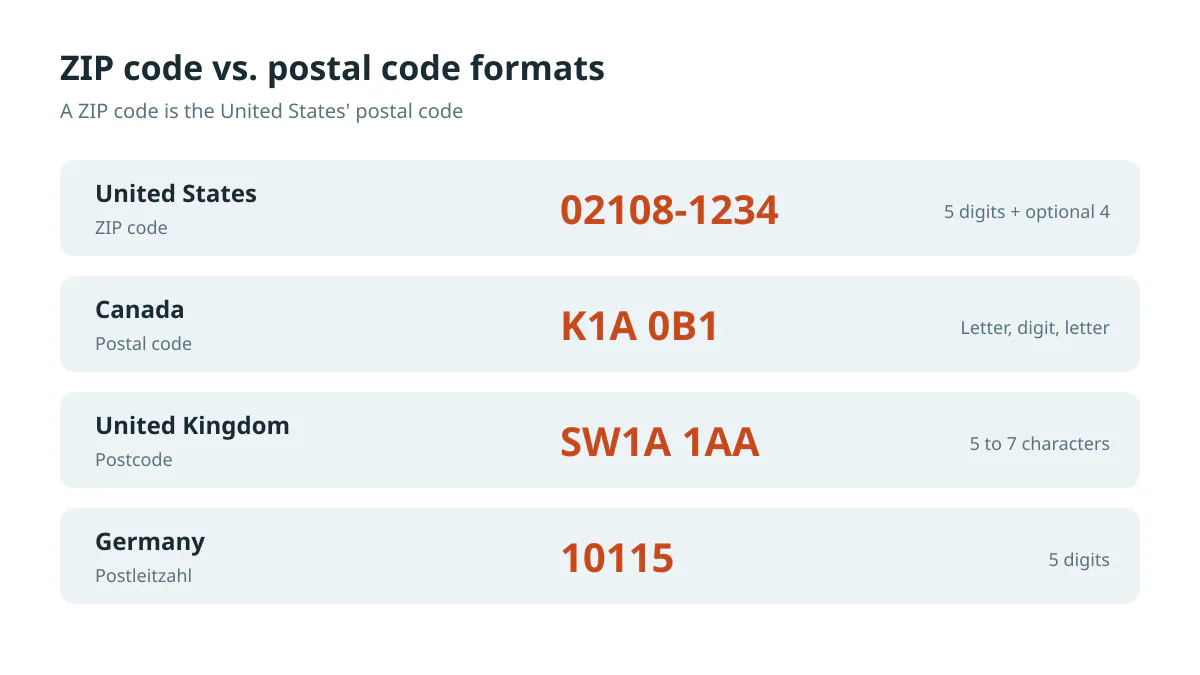
What to enter on a form
- U.S. address, field says “postal code”: enter your five-digit ZIP code (or ZIP+4 if the field allows nine digits).
- U.S. form, non-U.S. address: enter the local postal code exactly as written, letters and spaces included. If the form only accepts five digits, contact the business rather than inventing a number.
- Non-U.S. form asking for a “ZIP code”: it means your postal code.
Formats around the world
| Country | Local name | Format | Example |
|---|---|---|---|
| United States | ZIP code | 5 digits, or 5+4 | 02108 or 02108-1234 |
| Canada | Postal code | Letter-digit-letter, space, digit-letter-digit | K1A 0B1 |
| United Kingdom | Postcode | Outward and inward code, 5 to 7 characters | SW1A 1AA |
| Germany | Postleitzahl (PLZ) | 5 digits | 10115 |
| India | PIN code | 6 digits | 110001 |
| Brazil | CEP | 5 digits, hyphen, 3 digits | 01310-100 |
| Japan | 郵便番号 | 3 digits, hyphen, 4 digits | 100-0001 |
More countries: international postal codes.
Area code vs. ZIP code
An area code is the three-digit prefix of a North American phone number; a ZIP code is a five-digit postal code. They come from different systems run by different organisations, and there is no formula to convert one into the other. A three-digit number such as 213 or 646 is never a complete ZIP code, which is why our prefix and area-code guide and pages like 213 explain the difference.
Why the names differ
“ZIP” (Zone Improvement Plan) is the name USPS gave its system in 1963. Other countries named theirs in their own languages: Postleitzahl, código postal, CEP, PIN code. Postal-code terms around the world is a glossary.